
I *thought* I’d a written a piece all about the Moto Rumi Formichino before… but all I could find in the Lambrettista archives was this post – basically a paragraph, and period photo, and me saying “I thought I’d written a piece about Moto Rumi’s before…” Deja vu, all over again. Another bullet point for the ever expanding to do list!

I’m assuming my audience is familiar with the Rumi Formichino (if you’re not, there’s a picture above). It’s a lovely little scooter from a company based in Bergamo, Italy that made minature submarines and torpedoes for the Italian navy during WW2. Knowing that, gives some context to the unique design language of the Formichino (Italian for Ant, dontcha know). The Formichino did rather well in various sporting events of the day, and has a loyal following even now.
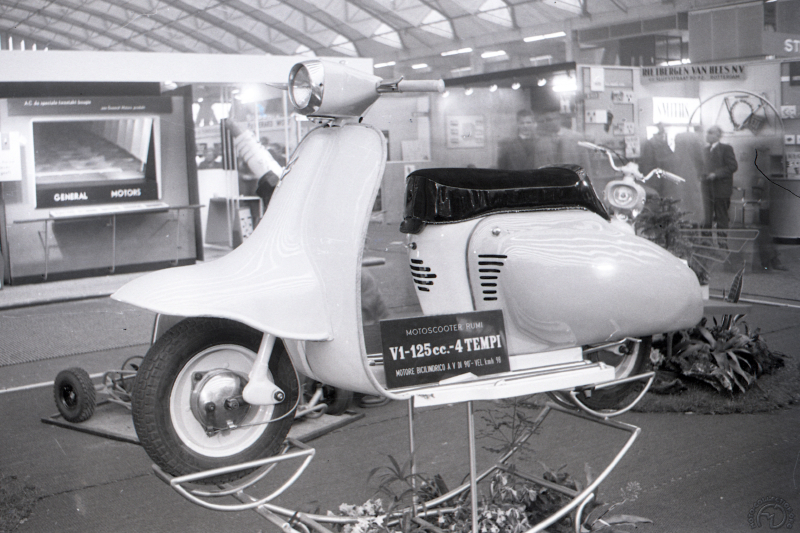
With that rather long-winded introduction out the way, and the Formichino acknowledged, we can now get to the meat of the post. Moto Rumi had plans for a quite breathtaking scooter, that sadly never made it into production. Ostensibly more a ‘traditionally’ styled scooter, with fully enclosed bodywork, the real innovations of the machine lie beneath those glorious streamlined shapes. But before we get to that, lets just dwell on the bodywork for a minute, shall we? Remember, this was 1960. So we’re talking circa LI Series 2 in Lambretta design terms. So this svelte little Rumi was definitely ‘up there’ in the design stakes.
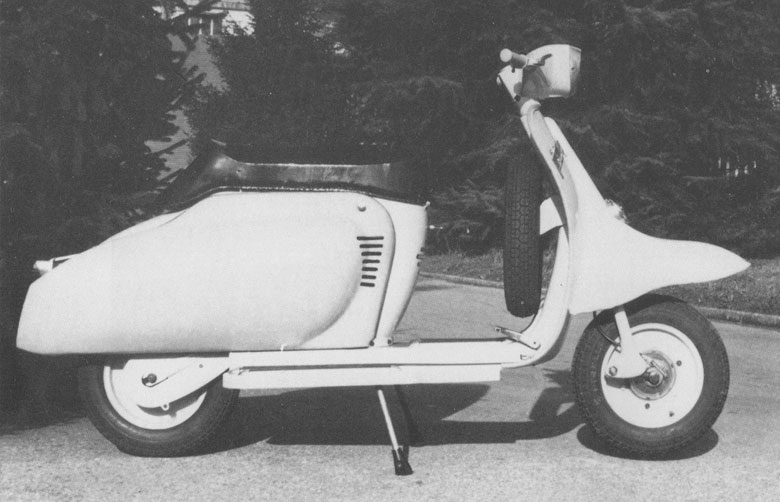
Under the panels there were more innovations…The Rumi having a very neat looking V-Twin, 4-Stroke engine – developed to be also used in the light motorcycles. On a motorcycle of course, you have to worry less about keeping the engine cool, something Rumi addressed by having ample venting cut into the all-steel bodywork, both at the front and the rear… the rear vents of course allowing the hot air to escape.

Those rear vents may have got a bit hot, but they look really cool – as is the line of that seat, smoothly merging into the bodywork of the machine at the back – way ahead of the bench seat of Lambretta’s TV’s – in the design stakes at least.
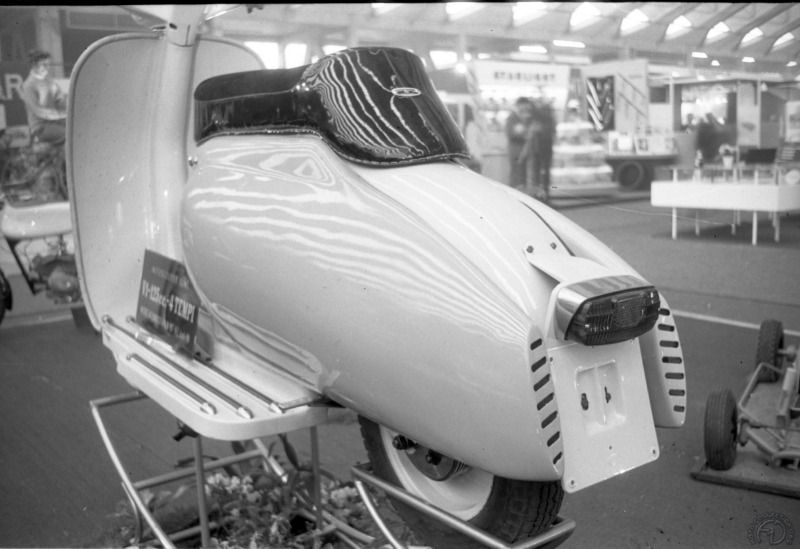
Available in 98, 125, and 175cc variants with hand-shift, four-speed gearboxes, these sleek little scooters would surely have given Lambretta and Vespa a run for their money, if they’d make it into production. Sadly, Moto Rumi went bust before that could happen.
While researching this article, I found out Moto Rumi made another scooter that I was unaware of, the Scoiottolo (or Squirrel), which pre-dates the Formichino. That to do list is getting longer…
Finally, here’s a couple of press pieces from the time. Thanks due once more to regular contributor Darrin Slack, who sent me the pictures and the story of the Moto Rumi’s that never were. The images and press articles are from the Amsterdam Salone of 1961, an important show of the time.


Find out more about Moto Rumi on this site: MotoRumi.IT.






 What’s the Buzz? The Buzz is the future. It’s electric. And it’s Vespa shaped. Aiming to do for the scooter market what Tesla have done for cars, Buzz is recreating yesterdays scooter style with tomorrows technology.
 The images shown are prototypes – the final design promising to morph into a ‘more modern take on this classic shop’ – well, I for one hope they don’t change too much. You know what side of the fence I sit on in the Vespa vs. Lambretta debate… but Vespas are the second most beautiful scooters ever made – so this retro styling looks pretty good!
 The two big ‘pain points’ with electric vehicles are range and charging. The Buzz scooters have a range of 240km – nearly 150 miles in old money. Pretty impressive. And improvements in battery tech could boost that to 400km. If your riding any more than that between charges, your doing some serious level scootering.
 There’s even an option with a removable roof system – featuring built in solar panels – the goal being you ‘ride for free’ and never have to plug your scoot into the grid. To be honest, I’d rather plug my scooter in once a day than ride around with a roof, but I think this would work well for delivery vehicles. Delivery vehicles in sunny places!
 There are many scooters labelled as ‘rare’. (especially on eBay!) Among the rarer Lambretta models are the Eibar Winter Models, GP Electronics, TV200’s (especially Spanish ones) which have a justifiable claim to the tag ‘rare’.
 Of course, it’s not just Lambretta models… the Vespa SS90 springs to mind from the Piaggio stable. And if we move away from the ‘big two’ the rarity value may step up a notch… with all the motorcycle (and car) manufacturers who tried to jump onto the ‘scooter boom’ of the fifties… Triumph, BSA, Peugeot even Harley Davidson and Ducati tried to get a piece of the action. But I honestly think I found the most exclusive scooter ever. It’s Italian (always a good thing when it comes to scooters), and is one of the most iconic marques in automotive history… Maserati.


 After yesterday’s electric Mogan three-wheeler, and with continuing dire warnings of an impending 2Stroke ban, I thought I’d continue the theme with this funky little electric scooter.
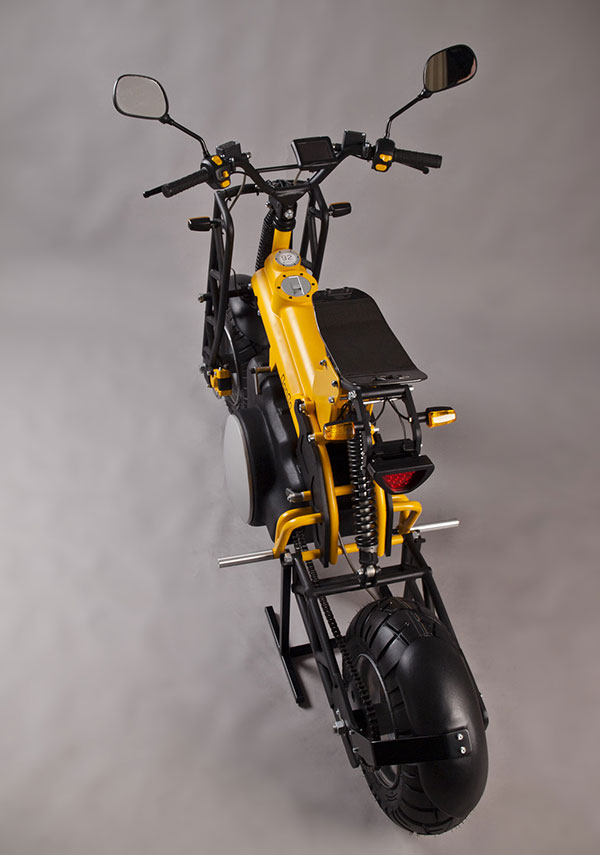
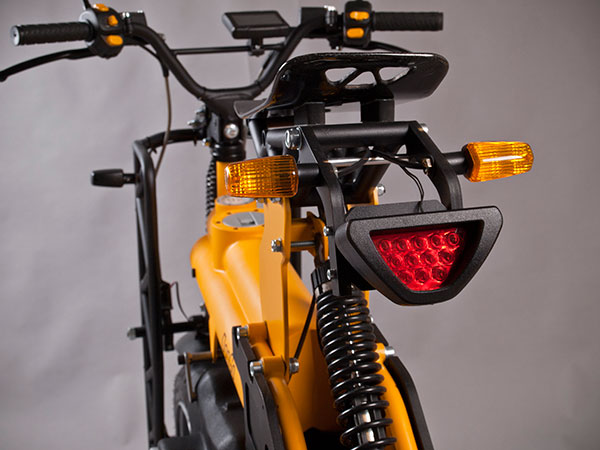
 Electric scooters are now pretty commonplace, but most are blandly generic, cheap and Chinese. It’s innovation that sets the ME electric scooter apart. Designed by a group of Italian engineers – it’s back to basic aesthetics are reminiscent of the early open-frame Lambrettas. Rather like the
  The ME is fitted with a lithium-ion battery, with a range of 80 km, fine for a daily commute (especially if you can plug it in when you get to work!) Its electric motor takes the scooter from zero to 45 km/h in six seconds.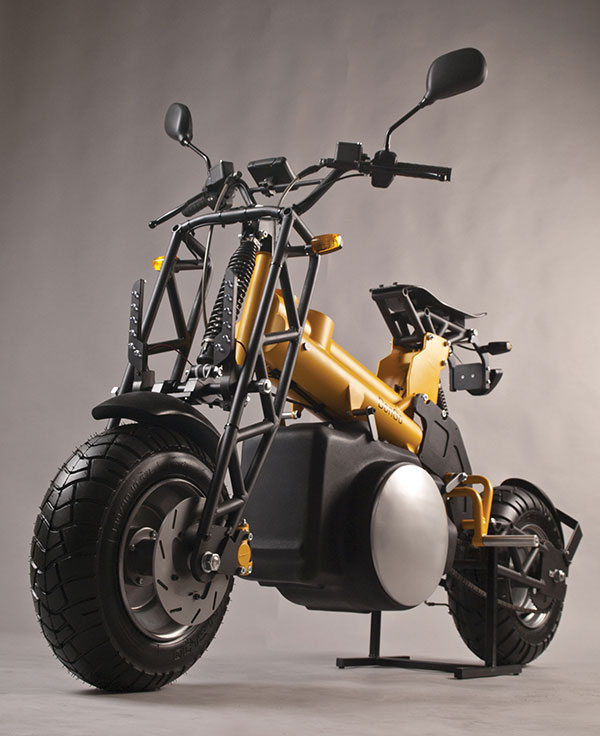










 lambrettista.net